Saturday, March 27, 2010

Red and Yellow

Something I've been made aware of is that there is an anti-government group which is protesting in Thailand. They're wearing red, so that's something that I should avoid while over there. (BBC News)
"Anti-government protesters have mounted a series of targeted demonstrations in the past two weeks, ranging from ritualistic blood curses to head-shaving to noisy parades through the streets of the capital... The red-shirts, a loose coalition of pro-democracy activists, supporters of the ousted prime minister, Thaksin Shinawatra, and former communists, deny any involvement with the blasts, which have not caused any serious damage or injury."


It also appears like there is another faction with yellow shirts which are opposite the red shirts. (BBC News)

Red Shirts: "The focus of many red-shirts' campaigning zeal is Thaksin Shinawatra, the prime minister ousted by the military in a September 2006 coup. By then Mr Thaksin had governed Thailand for five years. He was very popular among the rural poor, because he initiated policies that benefited them, such as funding for health-care and education.When elections were held 18 months after the coup, this rural support had not changed, even though Mr Thaksin was in overseas exile."


Yellow Shirts: "The focus of the yellow-shirts' campaign is also Thaksin Shinawatra - but they utterly oppose him. The yellow-shirts were behind the street protests that led up to the military coup of September 2006 - and the ones two years later that forced Mr Thaksin's allies from power.Called the Peoples' Alliance for Democracy (PAD), they are a loose grouping of royalists, businessmen and the urban middle class."

The Format

So while I'm over in Thailand, I'm going to post here everyday with text and some pictures. This will be a sort of journal of my study and travels aboard.

The current time setting for the blog is UTC +7 hours (as it is in Bangkok). EST is UTC -5 hours. This means that the clock is 12 hours ahead over there.

Summer 2009 - UMass Amherst

Last summer I went to the University of Massachusetts Amherst for the CURE summer REU program for ten weeks. UConn has an REU program but it's only for students of universities that don't have undergraduate research. This would be an opportunity to travel around the country (or at least within New England) and get to see how graduate students work on a project. Getting to shop around at other schools gives you a new perspective on have you have back home and what's out there for the future. I got to work with the Polymer Science and Engineering department there and it was pretty cool. I learned a lot about techniques and chemistry while I was there.


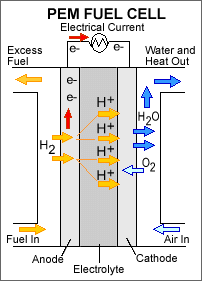
I was working with alkaline anion-exchange fuel cell membranes. A typical proton fuel cell works by breaking down water to give you two hydrogens, an oxygen, and some electrons (dihydrogen works too). You pass the hydrogens through the fuel cell membrane so they can recombine with the oxygen at the other side. This requires the electrons to also travel through the fuel cell and now you have electrons in motion - a current which can do work.


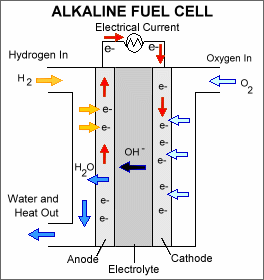
An alkaline fuel cell works with a catalyst breaking down your water or something like methanol to produce hydroxide anions (H2O minus the H) which cross the fuel cell membrane instead. This produces several notable advantages over proton fuel cells and if you were at the poster presentation my group gave, you probably saw me and my molecular models explain some of it. One of the main problems with fuel cells is how do you store the fuel (safely, efficiently) and how do you establish an infrastructure to disperse that fuel? Some fuels are easier to accomplish this with than others and some of those fuels only work with a proton or alkaline fuel cell, and vice versa. Different fuel cell types, and there are more than just these two, have numerous pros and cons.

Some things I learned at UMass:
-There are crazy ground bees in the woods when you go hiking.
-I'm not allergic to crazy ground bees.
-Flash chromatography. Pushing down on the valve slightly will turn a three-hour process into a one-hour one.
-Kinetics via NMR. I can run a sample and process the read-out much faster now. I'm also paranoid of hydrogen-deuterium exchange.
-How to set up a poster for a presentation.
-Always inquire about a meal plan before you arrive at your REU site. Don't preorder until you've scoped out the situation there. University dining in the summer isn't out to do anyone any favors.
-I can survive on Easy-Mac and Beefaroni for a summer (there were chips and cookies to go along with it, had a whole system down).
-I got to experience what a college town is really like. Massachusetts has a lot of good college towns. The situation with UConn is the inverse, where the campus is the only observable form of society around.

Summer 2010 - Mahidol University, Bangkok, Thailand

For this summer, I wanted to up the ante from the previous year. I've done domestic research at the home university, I've gone to another domestic university, and now I wanted to travel outside the country and see what it's like. For this, I applied to three sets of programs:
-University of Florida: going to Brazil, Argentina, or France (in that order of favorites)
-University of Syracuse: going to Austria
-University of Carolina Santa Cruz (UCSC): going to Thailand
Initially, I had wanted to go to Brazil. There I would be able to hang out in the rainforest and pick up on Portuguese (Brazilian-style). US and UCSC were both sort of second place contenders with Austria as more of a third place since it's kind of creepy over there and the euro is beating up the dollar now.

The transition for the Thailand trip to the first place spot was due to several things:
-If UF could not maintain a website and give the proper information or contacts, how were they supposed to keep me alive in another country? They switched coordinators and everything the day before applications were due and I made several phone calls which went unanswered.
-The Thailand REU coordinators were constantly in contact and available to answer questions.
-The Thailand REU responded first and I was uncertain about whether I would get into any other program. I had a week to accept so I did. Brazil came second (I was accepted) weeks later and Austria last (wasn't accepted, who cares?) even later. For last summer I had only applied to UMass's CURE program and its general REU program.

If you're curious about the program, check it out here:
http://www.chemistry.ucsc.edu/projects/thaireu/

So now we reach the present in the story so far. I've got my passport. The new ones are horrifically American - flags, eagles, and the red, white, and blue all over. It definitely screams 'insecurity'. Plus it comes with some kind of electronic tag in it which is supposed to who-knows-what in some nifty high-tech fashion. Now comes immunizations, I guess I have most of those already. The visa application is in the works. Once all that goes through, I'll be instructed on what airline to use (NSF-funded trips require an American vendor - fun fact). I'm also going to use my UConn Presidential Scholars fellowship toward giving me a stipend for food.

With all of this, I'm looking to gain the experience to be able to get into graduate school and pursue a Doctorate. I'm not sure whether that will be in just synthetic organic chemistry or something like polymer science. I'm leaning toward the latter by this point. I'm currently looking at institutions in the Connecticut/Massachusetts area of New England. And I'll have to take the GRE and GRE for chemistry before then. That should be after I come back, so October or November of 2010.

I think all undergraduates should take on one or more REU programs during their careers. It looks good and it does a lot toward helping you become a more independent member of the scientific community - dare I say, scientist or chemist? I'm not sure I'm at the point where I could be called either of those, but I try. Plenty of people I talk to about these programs don't even know the exist. A lot of the trip is paid for and you make several thousand dollars on a stipend with room and board paid for and travel is usually covered. Whether or not food is covered depends on the grant behind the program and there was one group at UMass that had an NSF food stipend of $20 a day which is astounding. We didn't, so you can see the diversity in how programs are run and what is available. From what I've seen, chemistry has many of these programs to offer as the chemistry community seems very well connected. And once you get into subfields, there are even more acquaintances.

Abbreviation Guide:
PLA = polylactic acid
ACS = American Chemical Society
CURE = Collaborative Undergraduate Research in Energy
REU = Research Experience for Undergraduates (or something like that)
NMR = Nuclear magnetic resonance (spectroscopy); it's essentially an MRI for molecules. Also, if you're a pre-Med/pre-Pharm know-it-all taking Chem 2444/5, then the NMR tech will destroy you if you sass them about the perceived hazards of a superconducting magnet 200k times more powerful than Earth's. I've seen it.
GRE = Graduate Recor

My Research - UConn

Since freshman year I have been doing independent research in the Institute of Material Science with biodegradable materials - specifically polylactic acid. At the time I was working with a grad student named Andrew and we attempted several reactions to change the material to improve its thermal properties. We were working with PLA pellets then and the processes we were trying didn't really pan out. Toward sophomore year I was handed off to another grad student Ben since Andrew was graduating. We did the same thing with lactic acid, the liquid monomeric form of PLA, and this arrived at the same 'results' more or less. I took the first semester of Junior year to perform a literature review and cook up some new ways of going about our trials for the past two years. By this time, Ben had graduated as well and the professor who had initially directed the research left UConn. I am now working mostly by myself on the project along with another grad student, David, who has been helping me with finding things or performing different lab techniques. This time around I'm working with lactide, a dimer of lactic acid, so I've worked with all three forms of the stuff by now. The project has become the basis for my Honors Thesis which is required for me to graduate with Honors. Today, things are looking good and it appears like the first step in a three or four part process is more or less over. I'll have to confirm this with my advisor. :p

One concept of significant importance to the whole work is 'green chemistry'. UConn has been among several institutions to really push forward on this idea and it was at an ACS presentation that several of our grad students really made an impact when they presented their work. Green chemistry is an awareness of the ecological and environment impact of chemistry when it is applied on any scale. As far as I see green chemistry, these are some important tenets (and I'm not an expert here):
-Solvent choice: Depending on what you want to do, your reaction mixture may end up as a hot soup of halogens and corrosive compounds. Water is the paragon of solvents when it comes to green chemistry. It's cheap, it's probably the most abundant compound on the surface of the planet, and it has some really interesting properties. The production of organic solvents produces by-products which must be disposed of/put where no one can see them, though often times the solvent or reagent is itself a by-product of one industry or another.
-Catalysts: Using a catalyst reduces the amount of material required to complete a chemical reaction. Less harmful (and expensive) materials are then needed. A big shift in catalysts are ones which allow a reaction to take place in water rather than organic/halogenated solvents. If you're working on an industrial scale, you'd save money by switching to water since a one liter bottle of carbon tetrachloride can cost $100, at least. One of the best things about a catalyst is that you should be able to recover it and use it again.
-Reduce Heavy Metals and Halogens: I can imagine having a dangerous compound that breaks down over time is not as hazardous as having a dangerous atom which won't break down or ever go away. Cadmium, cobalt, mercury, lead, etc. If you try and incinerate an atom, it's not going anywhere but up, into the sky. And then what goes up usually comes down. Of course, anything in high enough concentration will be lethal but when it gets to the point that we're afraid to eat animals because of our own contaminants we have a problem.

Now while my research delves into displacing fossil fuel plastics with a corn-based one, we must also be aware that it takes fossil fuel expediture to grow, care for, harvest, process, ferment, package, ship, unpackage, melt, stir, react, pour, and then ship the final shaped PLA material to wherever its going. This is probably the same route of production more or less for fossil fuel materials but it shows that we need to shift our infrastructure to greener means. However, at the end of the day the biodegradable materials can be broken down into their components or chewed up by bacteria to renew the cycle. When you buy a bottle now, it probably sees a week on the shelf before you pick it up and drink it in a half hour or however long. Then you trash it. And then it lasts forever in a landfill just so it could be used once or, if you just don't care, it ends up on the roadside. Civilization will rise and fall, metal will rust away to nothing, and entire landscapes will be swallowed up over time by the elements but that bottle may outlive it all.

So there is my background in undergraduate research at UConn and the philosophy behind it. I have a presentation to give in a few weeks (three, I believe) about my research so far. It's only 25% done but I'll show them what I have so far. I'll be at the 13th Annual Frontiers in Undergraduate Research Poster Exhibition on April 16th/17th at Wilbur Cross if you want to see my work (around 2-5pm and 11am-2pm). Friday is intended for the faculty and then Saturday I have to downplay the science jargon for the Open House. Even though this is pretty good advertisement for the University, I would still have to pay $50 for a poster which is 10% of the grant I received which is the whole reason why I have to present. Hmm. I'll probably print out individual pages and post them up. But there's a reception afterward with snacks so that's cool.

UConn Chem

Chemistry at UConn is rather interesting. There's a gorgeous new building that was completed before my freshman year and the labs there are squeaky clean for the most part. I'm not sure how many chemistry majors there are, but it's on the order of 100. Many are pre-Med or pre-Pharm and others, like myself, are looking at graduate school. There's the UConn Chem Club which does pretty well for itself. It's a tier 2 student organization and the ACS has been pretty impressed by its efforts. They also hosted part of the North Eastern Regionals Meeting this year. I was an officer sophomore year but wasn't reelected (I was going to be an RA anyway this year). However, there is less than stellar excitement among its members aside from the officers themselves. I've always thought that there's too much planning and not enough doing, lecturers should be brought in, and more should be done to improve the members themselves than just volunteer work. I'd like to see a glass-working seminar which might come in useful if I ever need to fit glassware for a set-up or just not break something accidentally then I need to get it unstuck.

If you want to do chemistry, there's also the Institute of Material Science (Friday is seminar day, if you like polymers) where I do research and I guess you can find your way into the Pharmacy Building too. All three buildings have all the fixings more or less for chemistry work. One thing I do not like about chemistry, and maybe this goes for other less populated majors (you crazy Turf Science folk), is that it doesn't get a lot of attention when it comes to events that the university or departments like Honors puts on. Biology, business, and psychology folk get a lot of special attention. Not that I'm bitter.

The whole path from domestic research at my home university to traveling to Thailand for a summer begins with my own research at UConn, which I like to talk about.

Getting Started!

Hello, I am currently a second semester Junior at the University of Connecticut Storrs. You may recognize UConn from its astounding women's basketball team which, if you're a college student reading this, has probably dominated your team by now by a 20 to 30 point victory.

I am majoring in Chemistry and pursuing a minor in Math. The minor will be completed next semester once I complete Math 3160 (Probability) and Math 3710 (Modeling). Credit-wise I'm something of a senior which has its benefits in pick times for housing or classes. Only three more chemistry classes before the major is completed, then it's thesis-writing time. I'm also a resident assistant for one of UConn's Honors housing communities.